No Faith No Art No King No Priest No God

Isaac Newton (iv January 1643 – 31 March 1727)[1] was considered an insightful and erudite theologian past his Protestant contemporaries.[2] [3] [4] He wrote many works that would now exist classified every bit occult studies, and he wrote religious tracts that dealt with the literal interpretation of the Bible.[5] He kept his heretical beliefs private.
Newton'due south conception of the physical world provided a model of the natural globe that would reinforce stability and harmony in the civic globe. Newton saw a monotheistic God every bit the masterful creator whose existence could not be denied in the confront of the grandeur of all creation.[6] [7] Although born into an Anglican family, and a devout but unorthodox Christian,[8] by his thirties Newton held a Christian faith that, had it been made public, would non have been considered orthodox by mainstream Christians.[viii] Scholars at present consider him a Nontrinitarian Arian.
He may accept been influenced by Socinian christology.
Early history [edit]
Newton was born into an Anglican family three months afterward the death of his father, a prosperous farmer also named Isaac Newton. When Newton was three, his female parent married the rector of the neighbouring parish of Northward Witham and went to live with her new husband, the Reverend Barnabus Smith, leaving her son in the intendance of his maternal grandmother, Margery Ayscough.[9] Isaac apparently hated his step-father, and had naught to practice with Smith during his childhood.[viii] His maternal uncle, the rector serving the parish of Burton Coggles,[10] was involved to some extent in the intendance of Isaac.
In 1667, Newton became a Swain of Trinity College, Cambridge,[eleven] making necessary his delivery to taking Holy Orders within seven years of completing his MA, which he did the post-obit year. He was likewise required to accept a vow of celibacy and recognize the Thirty-Nine Articles of the Church of England.[12] Newton considered ceasing his studies prior to completion to avoid the ordination fabricated necessary by constabulary of Rex Charles II.[ane] [13] He was eventually successful in avoiding the statute, assisted in this by the efforts of Isaac Barrow, as in 1676 the and so Secretary of State for the Northern Department, Joseph Williamson, inverse the relevant statute of Trinity Higher to provide impunity from this duty.[12] Newton so embarked on an investigative report of the early on history of the Church building, which developed, during the 1680s, into inquiries about the origins of organized religion. At around the same time, he adult a scientific view on motion and matter.[xiii] Of Philosophiæ Naturalis Principia Mathematica he stated:[14]
When I wrote my treatise nigh our Systeme I had an eye upon such Principles as might work with considering men for the beliefe of a Deity and nothing can rejoyce me more than than to observe it useful for that purpose.
Christian heresy [edit]
According to nigh scholars, Newton was Arian, not holding to Trinitarianism.[15] [16] [17] Scholars accept generally ended that Newton's heretical beliefs were self-taught, but he may have been influenced by so-current heretical writings; controversies over unitarianism were raging at the time.[15]
Likewise equally rejecting the Trinity, Newton's studies led him to pass up belief in the immortal soul, a personal devil, literal demons (spirits of the dead), and infant baptism.[15] Although he was non a Socinian, he shared many similar beliefs with them.[15] They were a unitarian Reformation movement in Poland. A manuscript he sent to John Locke in which he disputed the beingness of the Trinity was never published. In 2019, John Rogers stated, "Heretics both, John Milton and Isaac Newton were, equally most scholars now agree, Arians."[eighteen] [15]
Newton refused the sacrament of the Anglican church offered before his death.[eight]
Afterward his decease, Deists sometimes claimed him as i of their own, as have Trinitarians. In fact, he was a fundamentalist Christian who opposed both orthodox teachings and religious skepticism.[fifteen]
God as masterful creator [edit]
Newton saw God equally the masterful creator whose being could not be denied in the face up of the grandeur of all creation.[19] Nevertheless, he rejected Leibniz'south thesis that God would necessarily brand a perfect world which requires no intervention from the creator. In Query 31 of the Opticks, Newton simultaneously made an argument from design and for the necessity of intervention:
For while comets move in very eccentric orbs in all manner of positions, blind fate could never make all the planets motility 1 and the aforementioned mode in orbs concentric, some inconsiderable irregularities excepted which may have arisen from the mutual deportment of comets and planets on one another, and which volition be apt to increment, till this system wants a reformation.[twenty]
This passage prompted an attack by Leibniz in a letter to his friend Caroline of Ansbach:
Sir Isaac Newton and his followers take also a very odd stance apropos the work of God. Co-ordinate to their doctrine, God Almighty wants to wind up his spotter from time to time: otherwise it would cease to motion. He had non, it seems, sufficient foresight to make it a perpetual movement.[21]
Leibniz's letter initiated the Leibniz-Clarke correspondence, ostensibly with Newton'south friend and disciple Samuel Clarke, although as Caroline wrote, Clarke's letters "are non written without the advice of the Chev. Newton".[22] Clarke complained that Leibniz's concept of God as a "supra-mundane intelligence" who set up a "pre-established harmony" was merely a step from atheism: "And as those men, who pretend that in an earthly government things may keep perfectly well without the king himself ordering or disposing of any thing, may reasonably be suspected that they would like very well to set the king bated: then, whosoever contends, that the beings of the world can go on without the continual direction of God...his doctrine does in effect tend to exclude God out of the earth".[23]
In improver to stepping in to re-grade the Solar Arrangement, Newton invoked God's active intervention to prevent the stars falling in on each other, and perhaps in preventing the amount of motion in the universe from decomposable due to viscosity and friction.[24] In private correspondence, Newton sometimes hinted that the force of gravity was due to an immaterial influence:
Tis inconceivable that inanimate brute matter should (without the mediation of something else which is not textile) operate upon & affect other thing without mutual contact.[25]
Leibniz said that such an immaterial influence would be a continual miracle; this was another strand of his debate with Clarke.
Newton'southward view has been considered to be close to deism, and several biographers and scholars labelled him every bit a deist who is strongly influenced past Christianity.[26] [27] [28] [29] However, he differed from strict adherents of deism in that he invoked God as a special physical crusade to keep the planets in orbits.[16] He warned against using the law of gravity to view the universe as a mere automobile, similar a slap-up clock, proverb:
This most beautiful system of the sun, planets, and comets, could only proceed from the counsel and rule of an intelligent Beingness. [...] This Existence governs all things, non as the soul of the world, but as Lord over all; and on business relationship of his dominion he is wont to be called "Lord God" παντοκρατωρ [pantokratōr], or "Universal Ruler". [...] The Supreme God is a Being eternal, infinite, [and] absolutely perfect.[half dozen]
Opposition to godliness is atheism in profession and idolatry in do. Disbelief is then senseless and odious to mankind that it never had many professors.[30] [31]
On the other mitt, latitudinarian and Newtonian ideas taken as well far resulted in the millenarians, a religious faction defended to the concept of a mechanical universe, but finding in information technology the same enthusiasm and mysticism that the Enlightenment had fought so difficult to extinguish.[32] Newton may have had some interest in millenarianism, as he wrote nigh both the Volume of Daniel and the Book of Revelation in his Observations Upon the Prophecies.
Newton'due south concept of the physical earth provided a model of the natural world that would reinforce stability and harmony in the civic world.[32]
Bible [edit]
Newton spent a great bargain of time trying to find hidden letters within the Bible. After 1690, Newton wrote a number of religious tracts dealing with the literal interpretation of the Bible. In a manuscript Newton wrote in 1704, he describes his attempts to extract scientific information from the Bible. He estimated that the world would stop no earlier than 2060. In predicting this, he said, "This I mention not to assert when the time of the cease shall be, but to put a finish to the rash conjectures of fanciful men who are oftentimes predicting the fourth dimension of the stop, and by doing so bring the sacred prophesies into ignominy equally oft as their predictions fail."[33]
The Library of Trinity Higher, Cambridge, holds in its collections Newton'south personal copy of the King James Version, which exhibits numerous marginal notes in his hand as well equally well-nigh 500 reader's marks pointing to passages of particular involvement to him. A notation is attached to the Bible, indicating that information technology "was given by Sir Isaac Newton in his last illness to the woman who nursed him". The book was eventually bequeathed to the Library in 1878. The places Newton marked or annotated in his Bible bear witness to his investigations into theology, chronology, alchemy, and natural philosophy; and some of these chronicle to passages of the General Scholium to the second edition of the Principia. Some other passages he marked offer glimpses of his devotional practices and reveal distinct tensions in his personality. Newton's Bible appears to have been get-go and foremost a customized reference tool in the hands of a biblical scholar and critic.[34]
The Trinity [edit]
Newton's work of New Testament textual criticism, An Historical Account of Two Notable Corruptions of Scripture, was sent in a letter of the alphabet to John Locke on 14 Nov 1690. In it, he reviews evidence that the earliest Christians did not believe in the Trinity.[ citation needed ]
Prophecy [edit]
Newton relied upon the existing Scripture for prophecy, assertive his interpretations would set the record direct in the face of what he considered to exist, "and so niggling understood".[35] Though he would never write a cohesive trunk of work on prophecy, Newton'south beliefs would atomic number 82 him to write several treatises on the subject, including an unpublished guide for prophetic estimation titled Rules for interpreting the words & language in Scripture. In this manuscript, he details the requirements for what he considered to be the proper interpretation of the Bible.
Terminate of the world vs. Start of the millennial kingdom [edit]
In his posthumously-published Observations upon the Prophecies of Daniel, and the Apocalypse of St. John, Newton expressed his belief that Bible prophecy would not be understood "until the time of the cease", and that even then "none of the wicked shall empathise". Referring to that as a time to come time ("the last age, the age of opening these things, be at present approaching"), Newton also anticipated "the general preaching of the Gospel exist approaching" and "the Gospel must first be preached in all nations before the bully tribulation, and end of the globe".[36]
Over the years, a large amount of media attention and public interest has circulated regarding largely unknown and unpublished documents, evidently written past Isaac Newton, that indicate he believed the globe could terminate in 2060. While Newton besides had many other possible dates (due east.g. 2034),[37] he did not believe that the end of the world would have place specifically in 2060.[38]
Similar well-nigh Protestant theologians of his fourth dimension, Newton believed that the Papal Office and non any i detail Pope was the fulfillment of the Biblical predictions about Antichrist, whose rule was predicted to last for 1,260 years. They applied the day-year principle (in which a day represents a yr in prophecy) to certain central verses in the books of Daniel[39] and Revelation[40] (also known as the Apocalypse), and looked for meaning dates in the Papacy's ascension to power to brainstorm this timeline. Newton's calculation ending in 2060 is based on the 1,260-year timeline commencing in 800 Ad when Charlemagne became the first Holy Roman Emperor and reconfirmed the earlier (756 Advertising) Donation of Pepin to the Papacy.[33]
2016 vs. 2060 [edit]
Between the time he wrote his 2060 prediction (about 1704) until his death in 1727, Newton conversed, both first-mitt and past correspondence, with other theologians of his fourth dimension. Those contemporaries who knew him during the remaining 23 years of his life announced to be in understanding that Newton, and the "best interpreters" including Jonathan Edwards, Robert Fleming, Moses Lowman, Phillip Doddridge, and Bishop Thomas Newton, were eventually "pretty well agreed" that the 1,260-yr timeline should be calculated from the year 756 AD.[41]
F. A. Cox also confirmed that this was the view of Newton and others, including himself:
The author adopts the hypothesis of Fleming, Sir Isaac Newton, and Lowman, that the 1260 years commenced in A.d. 756; and consequently that the millennium will not begin till the yr 2016.[42]
Thomas Williams stated that this timeline had become the predominant view amongst the leading Protestant theologians of his time:
Mr. Lowman, though an earlier commentator, is (nosotros believe) far more than generally followed; and he commences the 1260 days from about 756, when, by aid of Pepin, Rex of France, the Pope obtained considerable temporalities. This carries on the reign of Popery to 2016, or sixteen years into the commencement of the Millennium, every bit it is generally reckoned.[43]
In April of 756 Advertizement, Pepin, King of France, accompanied by Pope Stephen 2 entered northern Italy, forcing the Lombard King Aistulf to lift his siege of Rome and render to Pavia. Following Aistulf's capitulation, Pepin gave the newly conquered territories to the Papacy through the Donation of Pepin, thereby elevating the Pope from being a subject of the Byzantine Empire to the head of state, with temporal ability over the newly constituted Papal States.
The end of the timeline is based on Daniel 8:25, which reads "he shall be broken without hand" and is understood to hateful that the finish of the Papacy will not exist caused by any deed.[44] Volcanic activeness is described as the ways past which Rome will exist overthrown.[45]
Antichrist will retain some part of his rule over the nations till near the twelvemonth 2016. And when the 1260 years are expired, Rome itself, with all its magnificence, will be absorbed in a lake of burn, sink into the sea, and rise no more at all for ever.[46]
In 1870, the newly formed Kingdom of Italy annexed the remaining Papal States, depriving the Popes of whatsoever temporal dominion for the next 59 years. Unaware that Papal dominion would be restored (albeit on a greatly diminished scale) in 1929 as caput of the Vatican City state, the historicist view that the Papacy is the Antichrist and the associated timelines delineating his rule speedily declined in popularity equally i of the defining characteristics of the Antichrist (i.e. that he would also be a political temporal power at the fourth dimension of the return of Jesus) were no longer met.
Eventually, the prediction was largely forgotten and no major Protestant denomination currently subscribes to this timeline.
Despite the dramatic nature of a prediction of the end of the world, Newton may not have been referring to the 2060 date as a subversive deed resulting in the annihilation of the earth and its inhabitants, only rather one in which he believed the world was to be replaced with a new one based upon a transition to an era of divinely inspired peace. In Christian theology, this concept is ofttimes referred to as The Second Coming of Jesus Christ and the establishment of Paradise by The Kingdom of God on Earth.[37]
Other beliefs [edit]
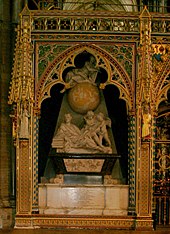
Henry More'south conventionalities in the universe and rejection of Cartesian dualism may have influenced Newton'south religious ideas. After works—The Chronology of Ancient Kingdoms Amended (1728) and Observations Upon the Prophecies of Daniel and the Apocalypse of St. John (1733)—were published afterward his death.[47]
Newton and Boyle's mechanical philosophy was promoted by rationalist pamphleteers as a viable alternative to the pantheists and enthusiasts, and was accepted hesitantly by orthodox clergy as well as dissident preachers like the latitudinarians.[32] The clarity and simplicity of science was seen as a way in which to combat the emotional and mystical superlatives of superstitious enthusiasm, as well as the threat of disbelief.[32]
The attacks made against pre-Enlightenment magical thinking, and the mystical elements of Christianity, were given their foundation with Boyle'south mechanical conception of the universe. Newton gave Boyle's ideas their completion through mathematical proofs, and more importantly was very successful in popularizing them.[47] Newton refashioned the world governed by an interventionist God into a globe crafted by a God that designs along rational and universal principles.[48] These principles were bachelor for all people to observe, allowed human being to pursue his own aims fruitfully in this life, not the next, and to perfect himself with his own rational powers.[49]
Writings [edit]
His first writing on the subject of organized religion was Introductio. Continens Apocalypseos rationem generalem (Introduction. Containing an explanation of the Apocalypse), which has an unnumbered leaf between folios 1 and 2 with the subheading De prophetia prima,[50] written in Latin some time prior to 1670. Written subsequently in English was Notes on early Church history and the moral superiority of the 'barbarians' to the Romans. His final writing, published in 1737 with the miscellaneous works of John Greaves, was entitled A Dissertation upon the Sacred Cubit of the Jews and the Cubits of the several Nations.[4] Newton did not publish any of his works of biblical study during his lifetime.[3] [51] All of Newton's writings on corruption in biblical scripture and the church took identify subsequently the late 1670s and prior to the middle of 1690.[3]
Run across also [edit]
- Classical mechanics
- Clockwork universe theory
- Religious and philosophical views of Albert Einstein
References [edit]
- ^ a b Christianson, Gale E. (xix September 1996). Isaac Newton and the scientific revolution . – 155 pages Oxford portraits in science Oxford University Press. p. 74. ISBN0-19-509224-iv . Retrieved 28 January 2012.
- ^ Austin, William H. (1970), "Isaac Newton on Science and Religion", Journal of the History of Ideas, 31 (4): 521–542, doi:ten.2307/2708258, JSTOR 2708258
- ^ a b c [English & LATIN] "The Newton Project Newton's Views on the Corruptions of Scripture and the Church". Retrieved 28 January 2012.
- ^ a b Professor Rob Iliffe (AHRC Newton Papers Project) THE NEWTON Projection – Newton's Religious Writings [English & LATIN] prism.php44. Academy of Sussex. Retrieved 28 January 2012.
- ^ "Newton's Views on Prophecy". The Newton Project. 5 April 2007. Retrieved 15 August 2007.
- ^ a b Principia, Book Three; cited in; Newton'due south Philosophy of Nature: Selections from his writings, p. 42, ed. H.S. Thayer, Hafner Library of Classics, NY, 1953.
- ^ A Short Scheme of the True Faith, manuscript quoted in Memoirs of the Life, Writings and Discoveries of Sir Isaac Newton by Sir David Brewster, Edinburgh, 1850; cited in; ibid, p. 65.
- ^ a b c d Richard Due south. Westfall – Indiana University The Galileo Project. (Rice University). Retrieved v July 2008.
- ^ Nichols, John Bowyer (1822). Illustrations of the literary history of the eighteenth century: Consisting of authentic memoirs and original letters of eminent persons; and intended as a sequel to the Literary anecdotes, Book 4. Nichols, Son, and Bentley. p. 32.
- ^ C. D. Broad (2000). Ethics and the History of Philosophy: Selected Essays. Vol. ane. Routledge. p. 3. ISBN978-0-415-22530-4.
- ^ Cambridge University Alumni Database Retrieved 29 January 2012
- ^ a b Professor Rob Iliffe (AHRC Newton Papers Project) THE NEWTON PROJECT prism.php15. University of Sussex. Retrieved 7 February 2012.
- ^ a b Cambridge University Library .air conditioning . Retrieved 29 Jan 2012.
- ^ S.D.Snobelen (University of King's Higher) – To Discourse of God : Isaac Newton's Heterdox Theology and Natural Philosophy Nova Scotia Retrieved 29 Jan 2012
- ^ a b c d e f Snobelen, Stephen D. (1999). "Isaac Newton, heretic : the strategies of a Nicodemite" (PDF). British Journal for the History of Science. 32 (four): 381–419. doi:10.1017/S0007087499003751. Archived from the original (PDF) on viii September 2014.
- ^ a b Avery Cardinal Dulles. The Deist Minimum. 2005.
- ^ Richard Westfall, Never at Balance: A Biography of Isaac Newton, (1980) pp. 103, 25.
- ^ John Rogers, "Newton's Arian Epistemology and the Cosmogony of Paradise Lost." ELH: English Literary History 86.1 (2019): 77-106 online.
- ^ Webb, R.One thousand. ed. Knud Haakonssen. "The emergence of Rational Dissent." Enlightenment and Religion: Rational Dissent in eighteenth-century United kingdom. Cambridge Academy Press, Cambridge: 1996. p19.
- ^ Newton, 1706 Opticks (2nd Edition), quoted in H. Thousand. Alexander 1956 (ed): The Leibniz-Clarke correspondence, Academy of Manchester Printing.
- ^ Leibniz, starting time letter, in Alexander 1956, p. 11
- ^ Caroline to Leibniz, ten Jan 1716, quoted in Alexander 1956, p. 193. (Chev. = Chevalier i.due east. Knight.)
- ^ Clarke, first reply, in Alexander 1956 p. fourteen.
- ^ H.W. Alexander 1956, p. xvii
- ^ Newton to Bentley, 25 February 1693
- ^ Force, James Eastward.; Popkin, Richard Henry (1990). Force, James East.; Popkin, Richard Henry (eds.). Essays on the Context, Nature, and Influence of Isaac Newton'south Theology. Springer. p. 53. ISBN9780792305835.
Newton has often been identified as a deist. ...In the 19th century, William Blake seems to have put Newton into the deistic camp. Scholars in the 20th-century have often continued to view Newton as a deist. Gerald R. Cragg views Newton as a kind of proto-deist and, every bit evidence, points to Newton's belief in a truthful, original, monotheistic religion first discovered in aboriginal times by natural reason. This position, in Cragg'southward view, leads to the elimination of the Christian revelation as neither necessary nor sufficient for homo knowledge of God. This agenda is indeed the key betoken, equally Leland describes higher up, of the deistic programme which seeks to "set bated" revelatory religious texts. Cragg writes that, "In consequence, Newton ignored the claims of revelation and pointed in a management which many eighteenth-century thinkers would willingly follow." John Redwood has too recently linked anti-Trinitarian theology with both "Newtonianism" and "deism."
- ^ Gieser, Suzanne (xiv Feb 2005). The Innermost Kernel: Depth Psychology and Quantum Physics. Wolfgang Pauli's Dialogue with C.Chiliad. Jung . Springer. pp. 181–182. ISBN9783540208563.
Newton seems to have been closer to the deists in his formulation of God and had no time for the doctrine of the Trinity. The deists did not recognize the divine nature of Christ. Co-ordinate to Fierz, Newton's conception of God permeated his unabridged scientific piece of work: God'southward universality and eternity limited themselves in the dominion of the laws of nature. Fourth dimension and space are regarded as the 'organs' of God. All is contained and moves in God but without having whatsoever effect on God himself. Thus space and fourth dimension become metaphysical entities, superordinate existences that are not associated with whatever interaction, action or observation on man's role.
- ^ McCauley, Joseph L. (1997). Classical Mechanics: Transformations, Flows, Integrable and Chaotic Dynamics . Cambridge University Printing. p. 3. ISBN9780521578820.
Newton (1642–1727), equally a seventeenth century nonChristian Deist, would take been susceptible to an accusation of heresy by either the Anglican Church or the Puritans.
- ^ Hans S. Plendl, ed. (1982). Philosophical bug of mod physics. Reidel. p. 361.
Newton expressed the same conception of the nature of atoms in his deistic view of the Universe.
- ^ Brewster, Sir David. A Short Scheme of the True Faith, manuscript quoted in Memoirs of the Life, Writings and Discoveries of Sir Isaac Newton Edinburgh, 1850.
- ^ "A curt Schem of the true Organized religion". The Newton Project. E Sussex: University of Sussex. Archived from the original on 7 May 2013. Retrieved 7 May 2013.
- ^ a b c d Jacob, Margaret C. The Newtonians and the English Revolution: 1689–1720.
- ^ a b "Papers Show Isaac Newton's Religious Side, Predict Date of Apocalypse". Associated Press. 19 June 2007. Archived from the original on 29 June 2007. Retrieved 17 May 2018.
- ^ Joalland, Michael. "Isaac Newton Reads the King James Version: The Marginal Notes and Reading Marks of a Natural Philosopher". Papers of the Bibliographical Lodge of America, vol. 113, no. iii (2019): 297–339 (https://www.journals.uchicago.edu/doi/abs/10.1086/704518?journalCode=pbsa)
- ^ Newton, Isaac (five April 2007). "The Kickoff Book Apropos the Linguistic communication of the Prophets". The Newton Projection. Archived from the original on 8 November 2007. Retrieved 15 August 2007.
- ^ Observations upon the Prophecies of Daniel, and the Apocalypse of St. John by Sir Isaac Newton, 1733, J. DARBY and T. BROWNE, Online
- ^ a b Snobelen, Stephen D. "Statement on the date 2060". Archived from the original on 15 Oct 2013. Retrieved 4 Feb 2014.
- ^ "A time and times and the dividing of times": Isaac Newton, the Apocalypse and 2060 AD Snobelen, S Tin J Hist (2003) vol 38 Archived 21 February 2014 at the Wayback Motorcar
- ^ the "time, times and half a time" of Daniel seven:25 and 12:seven
- ^ the "42 months" of Revelation 11:two and 13:v equals the "1260 days" of Revelation 11:3 and 12:6
- ^ Jonathan Edwards "History of Redemption" New York: T. and J. Swords (1793) page 431: "The Beginning of the reign of Antichrist.] The best interpreters (equally Mr. Fleming, Sir I. Newton, Mr. Lowman, Dr. Doddridge, Bp. Newton, and Mr. Reader) are pretty well agreed that this reign is to be dated from about A. D. 756, when the Pope began to be a temporal power, (that is, in prophetic language, a creature) by bold temporal dominion; 1260 years from this period will bring us to about A. D. 2000, and about the 6000th year of the globe, which agrees with a tradition at least every bit ancient as the epistle ascribed to the apostle Barnabas (f 15.] which says, that " in half-dozen thousand years shall all things be accomplished."
- ^ Rev. F.A. Cox "Outlines of Lectures on the Volume of Daniel" London: Westley and Davis (1833) second Edition Page 152
- ^ Thomas Williams "The Cottage Bible and family expositor" Hartford: D.F. Robinson and H. F. Sumner (1837) Vol. 2-folio 1417
- ^ Bishop Thomas Newton "DISSERTATIONS ON THE PROPHECIES" London: J.F. and C. Rivington (1789) 8th Edition Page 327: "As the stone in Nebuchadnezzar's dream was cutting out of the mountain without easily, that is non by homo, but by supernatural ways; and so the trivial horn shall be cleaved without hand, non die the mutual death, not fall past the hand of men, but perish by a stroke from heaven."
- ^ E Apthorp, D.D. "Discourses on Prophecy" (1786) Discourse Xi, Folio 273: "Rome the seat of Antichrist volition be consumed with fire, at the coming of Christ, or when the period of her apostacy is expired, in 1260 years from the rise of Antichrist." Folio 275: "...present Rome, when by an eruption of burn down the mountainous soil, being undermined, will fall into an abyss, and be covered with the ocean*
- ^ Rev. David Simpson "A Plea for Faith and the Sacred Writings" London: W. Baynes, and Paternoster-Row. (1808) 5th Edition, pages 131 and 133.
- ^ a b Westfall, Richard S. (1973) [1964]. Science and Religion in Seventeenth-Century England. U of Michigan Press. ISBN978-0-472-06190-7.
- ^ Fitzpatrick, Martin. ed. Knud Haakonssen. "The Enlightenment, politics and providence: some Scottish and English comparisons." Enlightenment and Religion: Rational Dissent in eighteenth-century United kingdom of great britain and northern ireland. Cambridge University Press, Cambridge: 1996. p64.
- ^ Frankel, Charles. The Faith of Reason: The Idea of Progress in the French Enlightenment. King's Crown Press, New York: 1948. p1.
- ^ The Newton Project, THEM00046, retrieved xx January 2014
- ^ James E. Strength; Richard Henry Popkin (1990). Essays on the Context, Nature, and Influence of Isaac Newton'south Theology. Springer Scientific discipline & Business Media. p. 103. ISBN978-0-7923-0583-5.
Further reading [edit]
- Eamon Duffy, "Far from the Tree" The New York Review of Books, vol. LXV, no. 4 (eight March 2018), pp. 28–29; a review of Rob Iliffe, Priest of Nature: the Religious Worlds of Isaac Newton, (Oxford University Press, 2017).
- Feingold, Mordechai. "Isaac Newton, Heretic? Some Eighteenth-Century Perceptions." in Reading Newton in Early Modern Europe (Brill, 2017) pp. 328-345.
- Feingold, Mordechai. "The religion of the young Isaac Newton." Annals of science 76.two (2019): 210-218.
- Greenham, Paul. "Clarifying divine discourse in early modernistic scientific discipline: divinity, physico-theology, and divine metaphysics in Isaac Newton'due south chymistry." The Seventeenth Century 32.ii (2017): 191-215 online.
- Iliffe, Rob. Priest of Nature: The Religious Worlds of Isaac Newton. Oxford University Press: 2017, 536 pp. online review
- Joalland, Michael. "Isaac Newton Reads the Rex James Version: The Marginal Notes and Reading Marks of a Natural Philosopher". Papers of the Bibliographical Social club of America, vol. 113, no. 3 (2019): 297–339 (https://www.journals.uchicago.edu/doi/abs/10.1086/704518?journalCode=pbsa)
- Manuel, Frank. Due east. The Religion of Isaac Newton. Oxford: Clarendon Printing, 1974.
- Rogers, John. "Newton'south Arian Epistemology and the Cosmogony of Paradise Lost." ELH: English Literary History 86.1 (2019): 77-106 online.
- Snobelen, Stephen D. "Isaac Newton, heretic: the strategies of a Nicodemite." British journal for the history of science 32.4 (1999): 381–419. online
External links [edit]
- Isaac Newton Theology, Prophecy, Scientific discipline and Religion – writings on Newton by Stephen Snobelen
- The Newton Manuscripts at the National Library of Israel – the collection of all his religious writings
Source: https://en.wikipedia.org/wiki/Religious_views_of_Isaac_Newton
0 Response to "No Faith No Art No King No Priest No God"
Post a Comment